Posts

On recognizing learning disorders: where do we stand?

Image
Photo by agu²! on Foter.com / CC BY-NC-SA   When Kandel said that “In the study of memory storage, we are now at the foothills of a great mountain range. We have some understanding of the cellular and molecular mechanisms of memory storage, but we need to move from these mechanisms to the systems properties of memory” (UCD, 2009), it was important to me to understand that his call addresses a move from a singular and isolated view to an effort from all parties involved in studying the mind-brain relation to consider the systemic view of how integration promotes diverse functions. As an educator, I have often noticed the isolation that practitioners of different – albeit interrelated – areas defend their praxis. It seems that the breaking into small parts that is so important to an accurate understanding of the limits that cognitive capacity forces upon processing of information have been taken to extremes (Craik & Lockhart, 1972; Green & Bavelier, 2008; Lo...

Research and Practice in Education - Still too far?!?

Image
The ‘bridge too far’ that Bruer preconized more than two decades ago (1997) still finds echo in today’s discussions. Is it applicable? Haven’t we crossed the bridge of responsible transdisciplinarity and translational research to application yet? Recent publications seem to contradict this. Let’s then examine why. Daniel (2012) states that “If we are truly interested in pursuing educational implications, it is important to understand that what works in a controlled context may have a very different effect when applied without the support inherent to high-quality curricular design” (2012, p. 252). By controlled context here, the intended meaning is the lab, where variables are carefully controlled to measure intended (or not) outcomes. To all intents and purposes, the idea that Daniel gives is that there should be controlled and well aligned experiments in the lab before they are translated into educational guidelines to improve learning in real classrooms. So far, so good...

On Learning, Motivation and Cognition

Image
Photo on <a href="https://foter.com/re/dafdf9">Foter.com</a> To dare speak about such a broad range of topics, one must decide on a perspective. Mine will be guided by time so let’s start getting all hands on deck to learn from the not-so-far-away decades of the 70s and 80s - a thrilling time for many - when the focus on mental associations created a propitious context for the appearance of the cognitive model for learning (Svinick, 1999). When we consider cognitivist models we come to an era where attention is drawn to the learners; their mental associations (phase I), metacognition (Phase II), and self-regulation (phase III) showed us that there are too many learner variables to consider (Svinicki, 1999). That led to a shift in our focus: if there are so many variables to consider, what concept would provide the underlying similarities through which we could understand the fundamentals of cognitive development? Memory came to fore and now we know th...

The History of Education - and the giants we all rely on

Image
Photo on <a href="http://foter.com/re/00cf88">Foter.com</a> Over the course of some past weeks, I had the delightful challenge of reading and revisiting the great giants that have contributed to our Education. We all have to refresh our memories about the colossal contributions that many scholars have bequeathed to humanity. The idea that we are more than the sum of our biological components has never failed to disquiet the minds of great thinkers. From the Greeks – Socrates, Plato and Aristotle – we have received the important legacy of man’s inherent ability to access knowledge. Through reflection, circumspection and perception, the belief that we are all born differently is firmly grounded in that legacy. Later, we received the legacy of instrumentality and the Romans conquered the world based on their need for minds that focused on a trade. The vocational tradition was then born and probably inspired much later behavioristic approaches. When relig...

Arts and Learning

Image
Photo credit: <a href="http://foter.com/re/171dcc">Foter.com</a> As I read about learning and its intricacies, I keep wondering how interconnected, and interdependent, everything that is related to learning is, by nature and design. From the prism of arts, we can take, for starters, the idea that no new learning happens if not based upon prior knowledge ( Tokuhama - Espinosa , 2010; 2014). The fact that Aristotle has developed the same idea through the notion of schemas seems only to confirm that nature lends itself to a kind of observation to the keen eyes of true educators who are willingly to dissect its secrets. It is only when each student's vast array of previously learned content is accessed that what is known (content to be learned) will find a way to bind into what is already familiar. As each one of us has a different repertoire of previous experiences, it makes sense to use arts to hook what is known to what is to be learned by ...

Novelty & Learning

Image
Photo credit: Steve took it via Foter.com / CC BY-NC-SA Our brains learn by contrasting what is new to what is known. It is the resulting factor that will account for a longer attentional focus and memory encoding that will lead to learning.  In considering this, the next challenge for a teacher is how to create novelty within the boundaries of some predictability so that kids feel safe to pay attention to the novel stimulus. Let me tell you a very successful example I had once the chance of video recording. In this class, 10 kids aged between 24 and 36 months were learning English as a second language. The teacher had for the class the objective of teaching hot and cold, concepts that they were already familiar with but that had to be attractive enough in the presentation stage so that they would feel motivated to use the content language (It’s hot/It feels hot or cold) in the second langue (English).  The teacher divided the room into two corners, prepare...

Emoticons in and for Education

Image
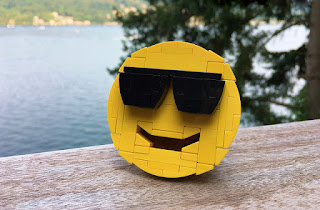
Photo credit: Ochre Jelly via Foter.com / CC BY-NC-SA Sometimes I wish emoticons were valued in education. Although it has been stated that “we will never know how any other animal or any other human actually feels” (Davis & Panksepp, 2011, p. 1947), I think they are a direct route to our amygdalae giving us an opportunity to gauge our emotional memory and prepare us for the get-go.  This ‘impulse that induces action’ (Tokuhama-Espinosa, 2016) is still very immaturely dealt within our society; no wonder when affective neuroscience is in its beginning (Davidson Films, 2010) and emotional intelligence is but a baby boomer. Whereas humans are still ahead in identifying emotions (Ekman, 1973 but Balkenius and Morin, 2001) but compete with other species in mirror neurons that fire for both action and observation modes (Gallese & Goldman, 1998), we still lack in cultivating emotional intelligence since infancy properly. It’s not a tradition to start the day by...